All published articles of this journal are available on ScienceDirect.

A Comprehensive Review on Therapeutic Potential of Mitragyna speciosa (Kratom) in Age-related Disorders
 iD
Nur Irlia Sofea Mohammad Zamani2 , *
iD
Felix Tan Yee Shuen2
iD
Aditya Bikram Raychaudhuri2
iD
Sana Fotedar2
iD
Ee Xin Sim1 , 3
iD
Haryati Ahmat Hairi4
iD
Rusdiah Ruzanna Jusoh4
iD
Hazwani Mohd. Yusof4
iD
Nurul Hamirah Kamsani5
iD
Faidruz Azura Jam4 , 6 , *
iD
iD
Nur Irlia Sofea Mohammad Zamani2 , *
iD
Felix Tan Yee Shuen2
iD
Aditya Bikram Raychaudhuri2
iD
Sana Fotedar2
iD
Ee Xin Sim1 , 3
iD
Haryati Ahmat Hairi4
iD
Rusdiah Ruzanna Jusoh4
iD
Hazwani Mohd. Yusof4
iD
Nurul Hamirah Kamsani5
iD
Faidruz Azura Jam4 , 6 , *
iD
Authors Info & Affiliations
Abstract
Global life expectancy has increased from 51 to 73 years over the last 60 years, demonstrating a longer lifespan for individuals worldwide. Although this has raised concerns about a rise in age-related disorders, current evidence suggests that mortality from these conditions has declined between 1990 and 2017, demonstrating that older people are generally healthier than ever. On the other hand, chronic diseases such as Alzheimer’s disease, Type 2 diabetes, Osteoarthritis, and Cardiovascular disease are still affecting millions, imposing a substantial burden on healthcare systems and caregivers. Current treatments are limited by side effects, regimen complexity, and modest effectiveness. Kratom (Mitragyna speciosa), a plant native to Southeast Asia, has been used in traditional medicine for many years. Rural communities have used its leaves either by chewing them or brewing them as tea for pain relief, blood glucose regulation, and overall health. Its primary active compounds, mitragynine and 7-hydroxymitragynine, exert their pharmacological effects by interacting with opioid receptors, offering analgesic and mood-enhancing properties. Recent studies suggest that Kratom may exhibit neuroprotective and anti-inflammatory properties, highlighting its therapeutic potential in age-related disorders. Despite its pharmacological properties, understanding of Kratom’s efficacy and safety is limited. Current evidence is primarily based on preclinical studies with limited clinical data; the long-term safety profile has not yet been established, especially regarding herb-drug interactions in older adults who usually take multiple medications. This review aims to explore the therapeutic potential of Kratom in supporting healthy ageing and managing age-related disorders. By examining both traditional uses and contemporary scientific evidence, this review provides a balanced view of its benefits and risks while identifying critical gaps to ensure its safe and effective use in elderly populations.
1. INTRODUCTION
The world is heading towards an unprecedented wave of ageing. Demographic trends reported by the World Health Organisation (WHO) show that the number of people aged 80 and above will triple compared to 2020 levels, reaching 426 million by 2050. With the expansion of the elderly population, age-related disorders such as Alzheimer's Disease (AD), Parkinson's Disease (PD), Type 2 Diabetes Mellitus (T2DM), Osteoarthritis (OA), and Cardiovascular Disease (CVD) are expected to become increasingly common [1]. These disorders continue to impose a significant burden on individuals, caregivers, and the healthcare system. Their management often requires complex therapeutic regimens, which can be complicated by drug interactions, side effects, and limited efficacy. As a result, there is growing interest in novel therapeutic strategies that combine multiple mechanisms of action with improved safety [2, 3].
Kratom (Mitragyna speciosa) belongs to the Rubiaceae family. It is a tropical tree native to Southeast Asia, particularly Thailand, Malaysia, Indonesia, and Myanmar. The tree can grow up to 15 to 30 meters in height and is characterized by large, glossy, dark green leaves that are oval in shape with prominent veins. The leaves have long been used as a traditional medicine in many parts of the world. Kratom leaves are often chewed or prepared as tea to relieve cough and pain. Its main alkaloids, namely mitragynine and 7-hydroxymitragynine, act on opioid receptors, producing analgesic, mood-enhancing, and neuroprotective effects. These therapeutic benefits make Kratom a potential candidate for the treatment of age-related disorders. However, it is worth noting that although Kratom products have been marketed as herb supplements in several countries, their safety profile from a public health perspective remains controversial and warrants further investigation [3, 4]. Current studies on Kratom are mainly focused on in vitro and preclinical research, which do not sufficiently provide a thorough understanding of its safety and the risk-benefit ratio [5]. Moreover, inconsistencies in Kratom’s composition and quality make it difficult to determine its effectiveness and safety profile. To address this, rigorous reviews and studies are required to improve the understanding, surveillance, and management of the public health consequences arising from the consumption of Kratom and its products [3].
This review examines Kratom’s possible application in age-related health conditions, highlighting its advantages, potential drawbacks, and the need for additional research to support its safe and reliable use. By considering its traditional uses alongside emerging scientific evidence, this review aims to provide a balanced perspective of Kratom’s potential in modern medicine and its relevance to the challenges of an ageing population.
2. METHODOLOGY
A literature review was conducted to identify studies related to the therapeutic value of Mitragyna speciosa (Kratom) in age-related disorders such as Osteoarthritis (OA), Cardiovascular Disease (CVD), Type 2 Diabetes Mellitus (T2DM), Alzheimer's Disease (AD) and Parkinson's Disease (PD). Literature was identified using electronic databases, including PubMed, Scopus, and Google Scholar. Relevant articles that had been published between 2000 and 2026 were screened, although seminal studies and significant findings published before 2000 were also included where appropriate. The search was executed by combining the keywords ‘Mitragyna speciosa’, ‘Kratom’, ‘mitragynine’, ‘7-hydroxymitragynine’ with ‘age-related disorders’, ‘osteoarthritis’, ‘cardiovascular disease’, ‘type 2 diabetes mellitus’, ‘Alzheimer's disease’, ‘Parkinson's disease’, ‘anti-inflammatory’, ‘antioxidant’, ‘neuroprotective’, ‘pharmacokinetics’. Only peer-reviewed, original research, clinical, and relevant reviews in the English language were considered. Studies solely based on forensic analysis, substance abuse, or non-pharmacological ethnobotanical information were removed. The included studies were qualitatively analyzed and synthesized based on the pharmacological effects, mechanisms of action, therapeutic effectiveness, pharmacokinetics, and safety of Kratom in age-related disorders.
3. BIOACTIVE COMPOUNDS & PHYTOCHEMICAL CONSTITUENTS OF KRATOM
Kratom contains many bioactive compounds with potential pharmacological relevance for age-related diseases. Its leaves contain up to 77% alkaloids, 13% polyphenols and flavonoids, and approximately 10% other compounds, including terpenoids, steroids, and fatty acids [6]. Among these phytochemical classes, alkaloids are the most extensively studied, with over 50 compounds isolated from Kratom leaves. Six alkaloids have been identified as pharmacologically active psychoactive substances, namely mitragynine, paynantheine, speciogynine, 7-hydroxymitragynine, speciociliatine, and mitraphyllin [7].
Mitragynine accounts for about 2% of the total dry weight of Kratom preparations and up to 66% of the total alkaloid content, whereas 7-hydroxymitragynine, its highly active oxidized metabolite, accounts for only 0.02% of the total alkaloid content. These alkaloids are produced by Kratom to help defend itself against environmental changes, including variations in soil type, chemotype, climate, and environmental stress [5]. Mitragynine is chemically known as 9-methoxy-corynantheidine, with a molecular composition of C23H30N2O4, and is a white amorphous powder soluble in alcohol, chloroform, and acetic acid [8]. Structurally, Kratom alkaloids contain indoles with variations in stereochemistry at positions C3, C15, and C20. Differences between mitragynine and related compounds such as speciogynine, speciocoliatine, and paynantheine arise from this stereochemical variation and may influence their pharmacological properties [9]. These compounds have also been characterized using Nuclear Magnetic Resonance (NMR) and mass spectrometry with differences in the chemical shifts of 1H and 13C signals, including deshielding effects at H3 and H17 [9, 10].
4. PHARMACOKINETICS (BIOAVAILABILITY, DISTRIBUTION AND PERMEABILITY)
Before considering Kratom as a therapeutic option for age-related disorders, it is important to understand the pharmacokinetic profile of its main alkaloids, mitragynine and 7-hydroxymitragynine. Mitragynine has low oral bioavailability (3%) and better solubility at gastric pH. This is due to its limited solubility in water and intermediate lipophilicity; however, its ionized state may inhibit direct diffusion. When administered intravenously, mitragynine demonstrated complete bioavailability. These observations are supported by an in vivo study showing that mitragynine’s solubility was 65 μg/ml in water, 3.5 mg/ml in a pH 4 buffer, and 19 μg/ml in a pH 9 buffer, suggesting enhanced solubility under acidic gastric conditions [10].
In terms of distribution, both mitragynine and 7-hydroxymitragynine are heavily protein-bound (> 90%), which facilitates tissue distribution, but may limit their ability to cross the Blood-Brain Barrier (BBB) [10, 11]. Following oral administration of 40 mg/kg mitragynine to rats, mitragynine was rapidly absorbed, reaching a maximum serum concentration (Cmax) of 0.63 ± 0.18 μg/mL at 1.83 ± 1.25 hours (Tmax), with an elimination half-life (t1/2) of 9.43 ± 1.74 hours. Mitragynine exhibited a high volume of distribution (VD/F, 89.50 ± 30.30 L/kg), likely due to its high affinity for lipid-rich tissues [8, 11, 12].
In terms of permeability, mitragynine showed better performance than 7-hydroxymitragynine, possibly resulting from its relatively high lipophilicity. Although both mitragynine and 7-hydroxymitragynine could cross the barrier, their high protein binding and the presence of P-glycoprotein (P-gp) may cause difficulties in crossing restrictive tight junctions of the Blood-Brain Barrier (BBB). However, their interactions with P-gp require further investigation, as current evidence is conflicting. These observations are supported by in vitro studies of BBB permeability using the MDR-MDCK epithelial cell model and two-dimensional cell-based models with the Caco-2 cell line, which have been used to study the intestinal permeability of mitragynine across the barriers by measuring the permeability coefficient (Papp). The results showed that mitragynine had a higher permeability (24.2 x 10^-6 cm/s) than 7-hydroxymitragynine (16.1 × 10^-6 cm/s) across Caco-2 cells, indicating its efficient absorption into the intestines [12].
Importantly, although some degree of CNS exposure has been observed in preclinical studies, the combined effects of high protein binding and active efflux transport likely result in restricted and variable brain bioavailability under physiological conditions. Therefore, CNS penetration cannot be assumed to be efficient or consistent. It should also be noted that most pharmacokinetic data are derived from either in vitro or in vivo studies, which may not fully translate to humans, particularly the elderly population. Drug disposition is altered in elderly patients due to changes in absorption, distribution, metabolism, and excretion, resulting from factors such as reduced hepatic and renal function, changes in body composition, and altered protein binding. BBB deterioration in elderly patients could enhance CNS permeability, influencing both efficacy and toxicity [13]. This highlights the need for targeted pharmacokinetic and pharmacodynamic studies of Kratom in an ageing population to better define its therapeutic potential and safety profile.
5. GENERAL PHARMACOLOGICAL EFFECT
Kratom’s diverse pharmacological profile reflects its broad range of biological activities, including analgesic, anti-nociceptive, neurological, anti-oxidative, anti-inflammatory, anti-bacterial, and gastrointestinal effects [4, 7, 14].
Antinociceptive properties of Kratom have been demonstrated in vivo models. Kratom extracts, including methanolic, alkaloid, and aqueous forms, have been found to delay pain stimuli in mice, particularly in the hot-plate test, where methanolic extracts showed greater potency. In the same experiment, these effects were not observed in the tail-flick test. However, another study demonstrated that oral administration of alkaloid (20 mg/kg), methanolic (200 mg/kg), and aqueous (400 mg/kg) extracts of Kratom increased pain response latency in both of the stated tests [15]. In both investigations mentioned, naloxone was shown to block the antinociceptive activity, indicating that opioid receptors are involved in the mechanism of action. The effects of Kratom and its principal alkaloid, mitragynine, on thermal nociception in rats were compared to those of morphine and oxycodone, two well-known and frequently misused opioids. In this investigation, when given orally and intraperitoneally (i.p.), mitragynine had antinociceptive effects comparable to those of oxycodone. This study showed that Kratom has characteristics similar to those of oxycodone and increases the risk of abuse, which may justify imposing limitations on the consumer marketplace [7, 16].
Besides pain-relieving effects, a study done on an animal behavioral model of depression with mitragynine indicated that mitragynine demonstrates antidepressant effects, which appear to be mediated by an interaction with the serotonergic system and show structural similarity to serotonin [11, 16]. Some preclinical studies suggested that prolonged exposure to Kratom may adversely affect neuroplasticity, with reports of impaired hippocampal synaptic plasticity and downregulation of neuroplasticity-related markers following chronic administration [17]. At the mechanistic level, Kratom alkaloids appear to influence reward-linked neuroadaptation via opioid–dopaminergic interactions and CB1-associated signaling, which may contribute to reinforcement and dependence risk [16, 18]. Motor performance is generally preserved with no consistent evidence suggesting gross motor impairment [19]. Although these pathways are not identical to those engaged by classical opioids, they remain relevant to addiction biology and longer-term neural remodeling.
Alongside these risk signals, neuroprotective effects have also been proposed in experimental systems. Reported mechanisms include antioxidant, anti-inflammatory, and anti-apoptotic actions that could plausibly mitigate oxidative stress and neuroinflammation implicated in neurodegenerative conditions [6, 7]. However, the current evidence base remains largely preclinical, while translational and clinical data are currently insufficient to support neuroprotection as a possible therapeutic claim.
Kratom's anti-inflammatory activity has been attributed primarily to its indole alkaloids, especially mitragynine, with potential contributions from polyphenols and flavonoids. Preclinical studies showed suppression of NF-κB–mediated signaling with reduced expression of TNF-α, IL-1β, IL-6, COX-2, and iNOS in activated immune cells [7, 20]. For example, Rahmawati et al. (2024) reported that Kratom alkaloid extracts exert dual inhibition of COX-2 and 5-LOX in LPS-stimulated RAW264.7 macrophages, significantly reducing the pro-inflammatory mediators [20]. Proposed mechanisms include both opioid receptor–dependent and receptor-independent effects, with biased G-protein signaling highlighted as a possible contributor to attenuated β-arrestin–linked inflammatory responses [4, 21]. The antioxidant properties of polyphenols and flavonoids further dampen oxidative stress-driven inflammation [7]. Collectively, these multi-target actions could be relevant to chronic inflammatory states in neurodegenerative, metabolic, and age-related disorders, but robust clinical validation is still limited [7, 16].
Kratom also exhibits strong antibacterial activity against a range of pathogens and prevents biofilm formation, suggesting its potential in controlling infection-associated inflammation. Recent studies demonstrated that Kratom extracts significantly inhibited the growth of Staphylococcus aureus and Methicillin-Resistant S. aureus (MRSA), as well as eradicated established biofilms of S. aureus (50 mg/mL, day 2) and Escherichia coli (100 mg/mL, day 2; 50 mg/mL, day 4) [19]. Additionally, antibacterial activity against Aeromonas hydrophila was observed, with a Kratom extract concentration of 24% producing the largest kill zone in disc diffusion assays [22].
Mitragynine has also been found to reduce gastric acid secretion and appetite in rat models. Additionally, it reduces stool frequency and suppresses the cholecystokinin levels in rats [7, 11]. Administration of mitragynine into the fourth ventricle inhibited 2-deoxy-D-glucose-induced gastric acid secretion, providing a mechanistic basis for its gastrointestinal effects [7]. Interestingly, Thai medicine is known to use the leaf and bark of the Kratom plant to manage diarrhea, as it contains the formulations of the YGBNR (“ya-gae-bid-na-ron”, a Thai herbal medicine), which also exhibits antioxidant and antibacterial activities, potentially enhancing its therapeutic efficacy [23].
Common adverse effects of Kratom include constipation, nausea, sleep disturbances, transient erectile dysfunction, sweating, pruritus, and tremors, as well as long-term consequences such as anorexia, weight loss, and hyperpigmentation. Some users reported hair loss, likely associated with frequent daily Kratom use. Other common withdrawal manifestations include muscular pains, impatience, mood swings, runny nose, diarrhea, and muscular jerks. With prolonged use, tolerance and cross-tolerance can develop to both Kratom and opiates [24].
6. PHARMACOLOGICAL MECHANISMS AND PRECLINICAL STUDIES OF KRATOM IN AGE-RELATED DISORDERS
Kratom has a long history of traditional use for pain relief, gastrointestinal disturbances, and general wellness, while modern preclinical studies demonstrate that Kratom exerts multi-targeted pharmacological effects such as anti-inflammatory, antioxidant, antibacterial, gastrointestinal-modulatory, and neuroprotective activities. These mechanisms are particularly relevant to age-related diseases characterized by chronic inflammation, oxidative stress, immune dysregulation, and gastrointestinal dysfunction, suggesting potential therapeutic roles in Type 2 Diabetes Mellitus (T2DM), Alzheimer’s Disease (AD), Parkinson’s Disease (PD), Osteoarthritis, and Cardiovascular Diseases (CVD).
6.1. Type 2 Diabetes Mellitus (T2DM)
One of the key features of patients with Type 2 Diabetes Mellitus (T2DM) is postprandial hyperglycemia, which is associated with starch hydrolysis [25]. There are two key enzymes involved in starch digestion: α-amylase and α-glucosidase. The process of starch digestion starts with the breakdown of polysaccharides into linear and branched malto-oligosaccharides by salivary α-amylase. This process is temporarily inhibited in the acidic environment of the stomach and resumes in the small intestine, where pancreatic α-amylase breaks down the oligosaccharides into maltose, maltotriose, and other smaller sugars.
Following this, α-glucosidases are responsible for further degradation into monosaccharides. The hydrolysed monomers are then transported into intestinal epithelial cells via specific transporters, such as SGLT1 (for glucose and galactose) or GLUT5 (for fructose), before entering the bloodstream through facilitated diffusion via the GLUT2 transporter in the basolateral membrane [25].
Slowing the rate of carbohydrate digestion can reduce the amount of glucose absorbed into the bloodstream, thereby lowering postprandial glucose levels. Accordingly, mitragynine and phenolic compounds in Kratom have been shown to inhibit the degradation of disaccharides into monosaccharides by pancreatic α-amylase and α-glucosidase in the small intestine [26], thereby indirectly preventing the absorption of dietary glucose mediated by SGLT1 and GLUT2 transporters localized at the apical side of enterocytes in the small intestine [25] (Fig. 1). A study conducted by Janthongkaw et al. (2023) [27] demonstrated synergistic inhibitory effects between mitragynine and quercetin on α-amylase and α-glucosidase, suggesting that the combined action of Kratom alkaloids and phenolics can more effectively suppress carbohydrate-digesting enzymes than either compound alone.
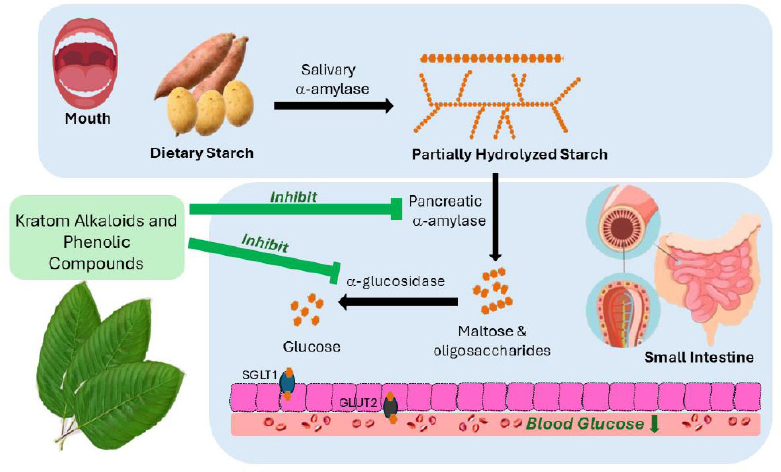
Proposed mechanism of antihyperglycemic action by Kratom alkaloids and phenolic compounds.
Preclinical studies suggest that Kratom possesses antidiabetic properties through mechanisms such as enzyme inhibition and antioxidant activity, as documented in Table 1. Evidence from human studies regarding the antidiabetic effects of Kratom remains limited; however, a recent study investigating the effects of Kratom tea on blood sugar levels among participants reported potential influences on glycaemic responses [27]. This effect could be attributed to its phytochemical constituents, which have been reported to inhibit the intestinal brush-border enzyme alpha-glucosidase, thereby delaying carbohydrate digestion and reducing the rate of glucose absorption. Consequently, any attenuation of postprandial blood glucose levels would likely occur through reduced glucose influx from the gastrointestinal tract.
| Study Design, Sampling/ Description | Findings | Reference |
|---|---|---|
| In vitro study of α-glucosidase and pancreatic lipase enzymes | Mitragynine exhibited stronger α-glucosidase inhibition than the antidiabetic drug acarbose but was less effective in inhibiting pancreatic lipase. Kinetic analysis revealed that mitragynine functioned as a noncompetitive inhibitor of α-glucosidase and a competitive inhibitor of pancreatic lipase. | [26] |
| In vitro study with pancreatic digestive enzymes (α-glucosidase and lipase) and acetyl-CoA carboxylase 1 | Mitragynine, a major constituent of Green Thai Kratom (GTK), demonstrated strong lipase-inhibitory activity and moderate α-glucosidase inhibition. In contrast, quercetin, detected in both Green and Red Thai Kratom extracts detected potent α-glucosidase inhibition but minimal lipase inhibitory effects. Combination inhibition studies demonstrated synergistic effects between mitragynine and quercetin on α-glucosidase activity. Both GTK and RTK extracts significantly reduced fat accumulation in 3T3-L1 adipocyte cells, with quercetin specifically inhibiting Acetyl-CoA Carboxylase 1 (ACC1), a key enzyme involved in fatty acid biosynthesis. | [27] |
| In vitro study with α-amylase, α-glucosidase, angiotensin-converting enzyme, and cholinesterases. | The study revealed that Kratom extracts inhibited acetylcholinesterase, butyrylcholinesterase, and α-glucosidase enzymes. The 95% ethanolic extract showed the highest activity against both butyrylcholinesterase and acetylcholinesterase. The 70% and 50% ethanolic extracts showed comparable effects on the α-glucosidase enzyme. However, all extracts were inactive against angiotensin-I-converting enzyme and α-amylase enzyme, suggesting that Kratom was unable to inhibit the conversion of starch into soluble polysaccharides or disaccharides. | [28] . |
6.2. Alzheimer’s Disease
Alzheimer’s Disease (AD) is a progressive neurodegenerative disorder that mostly affects the elderly population. It causes significant cognitive decline and memory loss [29]. Pathologically, AD involves Amyloid-β (Aβ) plaque accumulation, tau hyperphosphorylation, neuroinflammation, oxidative stress, and vascular contributions, collectively leading to neuronal dysfunction and degeneration [30-33].
Recent preclinical studies suggest that Kratom and its primary alkaloids, mitragynine and 7-hydroxymitragynine, may exert neuroprotective and cognitive-enhancing effects relevant to AD. Mitragynine, the most abundant alkaloid, is a partial μ-opioid receptor agonist and interacts with adrenergic/serotonergic systems, which attenuates neuroinflammation, oxidative stress, and excitotoxicity without the severe side effects of classical opioids, and its modulation of opioid receptors has been reported to provide therapeutic potential in neurodegenerative diseases including AD and PD [7, 21, 34].
Mechanistic studies indicate that mitragynine suppresses COX-2 expression and reduces the release of pro-inflammatory cytokines (TNF-α, IL-6, IL-1β), thereby attenuating microglial activation, while enhancing antioxidant enzyme activity, including glutathione peroxidase and superoxide dismutase, to protect neurons from ROS-mediated apoptosis [18, 35]. Furthermore, in silico and in vitro studies have demonstrated that Kratom alkaloids inhibit acetylcholinesterase, increasing acetylcholine availability and supporting learning and memory consolidation. This finding is corroborated by rodent behavioral studies showing improved spatial memory and object recognition performance [28, 36, 37].
Mitragynine also interacts with serotonin and adrenergic receptors, potentially providing anxiolytic effects that could alleviate neuropsychiatric symptoms associated with AD [21]. Preclinical models of morphine withdrawal further demonstrate that mitragynine promotes neuronal survival and mitigates functional impairment, suggesting its broader neuroprotective properties in neurodegeneration [37].
Although Kratom demonstrates promising multi-target mechanisms, the neuroprotective potential of Kratom should be interpreted cautiously. Available evidence is largely derived from in vitro systems and animal models that do not fully replicate the complexity of human AD. Moreover, the pharmacokinetic properties of Kratom alkaloids, including high protein binding and P-glycoprotein-mediated efflux at the blood-brain barrier, may limit CNS exposure in vivo, which may constrain translational efficacy.
Additionally, the current evidence reveals a biphasic dose-dependent effect profile. Low-to-moderate doses may improve cognition, while chronic high doses could impair function. This highlights the need for cautious dose optimization and comprehensive safety evaluation [4, 38]. Future studies should focus on disease-specific preclinical models and clinical trials to define optimal dosing and evaluate long-term risks, particularly in chronic use and cognitive adverse effects.
6.3. Parkinson’s Disease
Parkinson’s Disease (PD) is characterized by progressive impairment of voluntary movement resulting from the degeneration of dopaminergic neurons within the substantia nigra pars compacta and the reduction of dopamine signalling in the striatum. Apart from causing motor dysfunction, PD is often accompanied by non-motor features that may appear years before motor symptoms emerge. The non-motor symptoms, such as sleep disturbances, affective disorders, cognitive decline, and autonomic abnormalities, are caused by both dopaminergic and non-dopaminergic pathology [39, 40]. At the molecular level, the pathogenesis of PD is complex and characterized by diverse factors, including oxidative stress, mitochondrial impairment, accumulation of misfolded α-synuclein, and chronic neuroinflammation. Current pharmacotherapy strategies, such as levodopa and dopamine agonists, provide symptomatic relief but do not halt disease progression. This fuels the interest in plant-derived compounds with potential neuroprotective and disease-modifying properties [7, 41-45]. Current pharmacotherapies provide symptomatic relief but do not modify disease progression, driving interest in plant-derived compounds with potential neuroprotective properties.
Mitragynine functions as a partial μ-opioid receptor agonist. It interacts with adrenergic, serotonergic, and glutamatergic systems, suggesting a possible influence on both motor and non-motor aspects of PD. Mitragynine activates the Nrf2 signaling pathway and upregulates the expression of heme oxygenase-1 and NADPH quinone dehydrogenase 1. The upregulation of these endogenous antioxidant enzymes helps to counteract oxidative stress, which is a major contributor to dopaminergic neuron loss [7, 46, 47].
Several preclinical studies have reported the potential of Kratom alkaloids as neuroprotective agents in PD. An in vivo study using a PD zebrafish model exposed to the neurotoxin 1-methyl-4-phenyl-1,2,3,6-tetrahydropyridine (MPTP) reported that alkaloid-rich Kratom extract preserved dopaminergic neurons, reduced PD-like histopathological changes, and improved locomotor activity. These findings suggest that Kratom demonstrates neuroprotective effects against acute dopaminergic toxicity in the MPTP zebrafish model [48].
However, the current evidence remains preliminary and largely based on toxin-induced or pharmacological models that reflect acute dopaminergic disruption rather than progressive neurodegeneration. Moreover, these studies do not directly demonstrate the preservation of dopaminergic integrity through key disease markers such as tyrosine hydroxylase expression, dopamine levels, or α-synuclein aggregation. Importantly, the pharmacokinetic limitations of Kratom alkaloids, including high plasma protein binding and P-glycoprotein-mediated efflux at the blood-brain barrier, may restrict CNS exposure, which is critical for disease-modifying effects in PD.
Notably, Kratom’s role is not unequivocally protective. Developmental exposure studies in adolescent rats exposed repeatedly to mitragynine or lyophilised Kratom decoction revealed behavioural impairment and altered brain metabolite profiles, implicating pathways affected in PD such as the arachidonic acid pantothenate, CoA and tryptophan metabolisms. These findings suggest that early-life Kratom exposure may increase vulnerability to PD-relevant molecular cascades [49].
Overall, while Kratom is known for its anti-inflammatory, antioxidant, and neurotransmitter-modulatory properties, the current evidence supporting its use in PD remains preliminary. The mechanistic interpretation of Kratom in PD is predominantly indirect, rather than direct validation of dopaminergic integrity, such as tyrosine hydroxylase expression, dopamine levels, or α-synuclein aggregation. To advance Kratom as a potential candidate for PD neuroprotection, future studies should employ standardized extract characterisation, robust mechanistic validation, and long-term safety assessment in mammalian PD models.
6.4. Osteoarthritis
Osteoarthritis (OA) is a common type of arthritis characterized by cartilage degeneration, subchondral bone changes, and synovial inflammation primarily in weight-bearing joints, leading to pain, stiffness, and reduced function [50, 51]. It primarily occurs in adults above 40 years of age, and its prevalence increases gradually with age, as there is no effective treatment that can cure the disease. According to Steinmetz et al. (2023), 595 million people were reported to have OA in 2020, reflecting a significant 132.2% increase over 1990 [52].
Kratom and its bioactive alkaloids, particularly mitragynine and 7-hydroxymitragynine, have not been proven to cure OA directly, but they may provide pharmacological benefits in managing the symptoms of the disease. Mitragynine, being a partial μ-opioid receptor agonist that does not recruit β-arrestin, produces analgesic effects with a lower risk of side effects typically seen with conventional opioids, such as respiratory depression, constipation, nausea, and vomiting. This is essential for managing chronic OA pain in older patients. Additionally, mitragynine has been shown to interact with α-2 adrenergic receptors and inhibit the production of pro-inflammatory mediators, potentially reducing synovial inflammation and pain. Furthermore, mitragynine also inhibits Cyclooxygenase-2 (COX-2) mRNA expression. COX-2 catalyses the production of the inflammatory mediator, Prostaglandin E2 (PGE2); therefore, inhibiting COX-2 may have anti-inflammatory effects, protecting joints from further degradation.
While general anti-inflammatory and antioxidant effects of Kratom have been recorded, there is limited research linking the effects of Kratom to OA-specific mechanisms directly, such as cartilage preservation and modulation of joint biomechanics. An in vitro study with LPS-induced RAW 264.7 macrophage cells carried out by Siti Irma Rahmawati et al. (2024) suggested that the Kratom alkaloid extract caused significant reductions in inflammatory markers, including reactive oxygen species, nitric oxide, TNF-α, and IL-6 production [20]. Another in vivo study in rat models by Mahaprom et al. (2025) highlighted the antinociceptive and anti-inflammatory effects of Thai Herbal Kratom, whereby oral administration of this extract reduced paw oedema and topical administration prevented ear oedema [53].
However, these models mainly reflect acute chemically induced inflammation and generalized nociceptive responses, which differ from the chronic, low-grade inflammatory and biomechanical processes underlying OA, including cartilage degradation and subchondral bone remodeling. Therefore, while these findings suggest that Kratom possesses anti-inflammatory and analgesic properties, they do not directly establish its efficacy in alleviating OA pathology or progression. Overall, Kratom may have potential in symptom management, particularly for pain and inflammation. Despite this, specific effects on OA-related structural changes remain unclear and require further investigation using disease-relevant preclinical models and well-designed clinical studies.
6.5. Cardiovascular Disease and Hypertension
In 2019, Cardiovascular Disease (CVD) was the underlying cause of 9.6 million deaths among men and 8.9 million deaths among women, accounting for around one-third of all deaths worldwide. The Global Burden of Diseases, Injuries and Risk Factors (GBD) 2019 identified high systolic blood pressure, dietary risks, elevated Low-Density Lipoprotein (LDL) cholesterol, air pollution, high body mass index, tobacco smoking, high blood sugar levels, and kidney dysfunction as the primary modifiable risk factors that cause these trends [54].
The available preclinical evidence on the cardiovascular effects of Kratom is summarized in Table 2. Existing evidence indicates that lower blood cholesterol levels are associated with a lower risk of Coronary Heart Disease (CHD), consistent with the lipid hypothesis [55]. The bioactive alkaloids of Kratom, which include mitragynine and 7-hydroxymitragynine, have been associated with reduced serum lipid levels. These alkaloids have the potential to alter lipid metabolism by modulating enzyme activity and lipid absorption in the digestive tract [56]. A study that included 100 Kratom users and 100 healthy controls found that Kratom users had slightly lower serum total cholesterol and low-density lipoprotein cholesterol levels [56]. The study conducted by La-up et al. (2021) reported an association between Kratom consumption and two specific blood lipid measurements: low triglyceride levels and high HDL [57]. The study conducted by Darshan Singh et al. (2018) reported similar findings, demonstrating that Kratom users exhibited higher HDL levels than the control group [58]. However, these findings may have been influenced by confounding factors such as diet, physical activity, socioeconomic status, and other lifestyle variables, which were not fully controlled. Multiple studies have demonstrated that increased HDL levels are associated with cardioprotective effects [57]. The process of HDL-mediated cholesterol transport involves the movement of cholesterol from arterial and bodily tissues back to the liver. The liver processes cholesterol through two methods: either reusing it or disposing of it from the body. The process helps reduce cholesterol buildup in arterial walls, thereby limiting the development of atherosclerosis. A review of clinical studies suggested that a 7.5% increase in HDL levels may be associated with reduced atherosclerotic progression [59]. However, using cross-sectional data alone does not support predictions about preventing atherosclerosis or other heart-related outcomes. More longitudinal and controlled studies are needed to determine if these associations show a real causal decrease in cardiovascular events.
| Study Design, Sampling/ Description | Findings | References |
|---|---|---|
| In vitro study with hERG1a/1b-transfected HEK293 cells. | Mitragynine inhibits the rapidly delayed rectifier potassium (Ikr) current in the myocardium in a concentration-dependent manner, indicating a potential proarrhythmic risk through direct ion channel suppression. Mitragynine may impair hERG1a trafficking by inhibiting proper hERG1a channel protein folding through the plasma membrane of transfected HEK293 cells, and may contribute to delayed cardiac repolarization and increased susceptibility to arrhythmias. |
[67] |
| In vitro study with hERG-HEK293 and hiPSC-CMs cells | Mitragynine and its substitutes may enhance Torsade de Pointes or a specific type of ventricular tachycardia by inhibiting rapid delayed rectifier potassium current (Ikr) in human cardiomyocytes. | [65] |
Oxidative stress and inflammation have important roles in lipid regulation. Kratom contains phenolic compounds with antioxidant activity that may reduce oxidative damage [60]. Phenolics' antioxidant qualities are based on their chemical structure, which includes hydroxyl groups bound to aromatic rings. To stop continuous chain reactions from causing cellular damage, the compound's hydroxyl groups donate hydrogen atoms to stabilize free radicals [61]. By neutralizing free radicals, the antioxidants in Kratom reduce oxidative damage to the endothelium and limit the growth and spread of atherosclerotic plaques. Superoxide Dismutase (SOD) and reduced Glutathione (GSH) levels significantly increased after Kratom treatment, while MDA levels concurrently decreased [60]. GSH plays a crucial role in the cardiovascular system by acting as a major antioxidant that restores intracellular redox balance and prevents the degradation of nitric oxide produced by the endothelium, leading to reduced abnormal vasomotor reactivity in individuals with coronary spastic angina [62]. SODs are metalloproteins that catalyze the conversion of hydrogen peroxide from superoxide anion. In humans, it is the most potent antioxidant enzyme. In fact, SODs stop the production of peroxynitrite by detoxifying the superoxide anions and preventing their interaction with nitric oxide [63].
Hypertension is a risk factor that may promote CVD. The relationship between Kratom and hypertension is complex, as the effects of Kratom on blood pressure depend on the dose, frequency of use, or a person's physiological response. While some research reports point to the potential hypotensive effects of Kratom at a lower dose, others indicate an increased risk of hypertension associated with long-term or high-dose use. Activation of mitragynine and 7-hydroxymitragynine, which are known as partial agonists at μ-opioid receptors, may reduce pain and stress, which in turn may decrease sympathetic nervous activity. The sympathetic outflow of Kratom diminishes with the lowering of the heart rate and vasoconstriction, which can eventually reduce blood pressure. Therefore, blood pressure may be reduced through the central nervous system, similar to the mechanism of action of some opioid analgesics [21]. A few of the alkaloids in Kratom may also activate α-2 adrenergic receptors, inhibiting the release of norepinephrine, which causes vasodilatation [7]. Its antioxidant components, such as flavonoids, phenolics, and tannins, aid in lowering oxidative stress and keeping blood vessels healthy by shielding endothelial cells from oxidative damage. This may reduce arterial stiffness, thereby lowering hypertension. Tannins aid by stimulating antioxidant enzymes involved in ROS scavenging activities while also inactivating metal ions created by free radicals [64].
As Kratom causes tolerance and withdrawal symptoms, users have reported varying blood pressure readings. According to Abdullah and Singh (2021), tachycardia (21.4%), hypertension (10.1%), conduction defects (2.8%), chest pain (2.6%), hypotension (1.8%), bradycardia (1.2%), and cardiac arrest (0.4%) are some of the cardiovascular side effects of Kratom. Kratom's active ingredient, mitragynine, also may affect the heart, causing prolonged QTc intervals that can result in torsades de pointes, a form of polymorphic ventricular tachycardia [65]. Additionally, mitragynine has been linked to cardiorespiratory arrest and ventricular arrhythmia [66]. Kratom can also enhance cardiovascular risk, especially when consumed in large quantities over an extended period [19].
Taken together, the effects of Kratom on the cardiovascular system are complex (Fig. 2). Potential metabolic and vascular effects raise significant safety concerns. While some studies reported modest improvements in lipid profile and antioxidant status, the current findings are largely observational and insufficient to prove a cardioprotective benefit. Moreover, preclinical and clinical evidence highlights cardiotoxic risks to QT prolongation and torsades de pointes, as well as reported cases of ventricular arrhythmias. These electrophysiological risks are especially relevant in elderly individuals, who have reduced cardiac repolarization reserve and higher susceptibility to drug-induced arrhythmia. Finally, when both aspects are considered together, the potential lipid-related benefits are outweighed by the clinically significant risk of fatal arrhythmias.
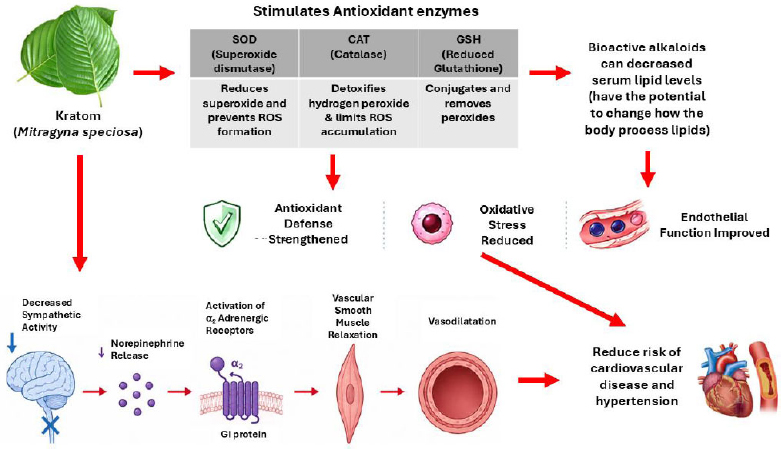
Proposed mechanisms underlying the cardiovascular protective effects of Kratom.
7. CLINICAL TRIALS AND HUMAN STUDIES ON KRATOM AND AGE-RELATED DISORDERS
Evidence from both clinical trials and human studies suggests that Kratom could have therapeutic relevance in several age-related disorders, including OA, CVD, T2DM, and neurodegenerative conditions such as AD and PD. In addition to its reported analgesic effects, Kratom has been associated with anti-inflammatory, antioxidant, gastroprotective, as well as neuroprotective effects. In the context of OA, these combined effects may contribute to better pain control and consequently, improved quality of life. Kratom has the potential to modulate metabolic and neurodegenerative pathways (Table 3). However, the current evidence remains limited. Controlled clinical trials are scarce, and most available data are derived from observational studies, self-reported surveys, and small case series. Notably, some studies are limited by small sample sizes. These limitations, together with heterogeneity in study designs, the lack of standardized dosing regimens, and incomplete reporting of exposure duration, restrict the generalizability of findings to broader clinical populations. Interpretation of these findings should therefore be approached with caution, as several human studies involve small sample sizes, observational designs, self-reported outcomes, and in some cases incomplete reporting of participant characteristics.
| Therapeutic Domain | Study Design/ Population | Dosage/ Duration | Findings/ Effects Assessed | Specific Therapy Efficacy Tested | Reference |
|---|---|---|---|---|---|
| Analgesic/ Pain Management | Online survey of US adults (n = 8,049) |
Variable: self-reported use | Analgesia, mood modulation, opioid withdrawal symptoms | Pain relief, opioid withdrawal management | [68] |
| Poison center case series (n = 12) | Acute exposure; variable dose | Mild-moderate toxicity and clinical outcomes | Safety profile, potential analgesic | [69] | |
| Cross-sectional study, opioid polydrug users in Malaysia (n=204) | Regular use, duration and dose not reported | Reduced opioid withdrawal symptoms, analgesic effects | Opioid withdrawal and analgesia | [70] | |
| Glycemic/ Metabolic (T2DM-relevant) | Experimental crossover study (n = 10) | Single session: glucose vs. glucose + 1% Kratom tea | Reduced postprandial glucose response (AUC reduction); mean ± SD reported | Postprandial glucose modulation | [71] |
| Meta-analysis of observational studies (n≈1,458) | Mixed exposure; generally chronic habitual use | Kratom users had lower LDL, TG, BMI, and higher HDL; no significant effect on blood glucose | Metabolic syndrome/ cardiometabolic risk | [72] | |
| Neurological/ Seizure Effects | Case series (n = 3) – epilepsy and seizures | Chronic use before events | Recurrent seizures associated with chronic Kratom use; no variance reported | CNS excitability/risk | [73] |
| Neuroprotective/ Cognitive Effects | Cognitive assessment – long-term users (n = 95) | Long-term habitual use | Mild cognitive effects; some deficits in memory/executive function; results reported as mean ± SD | Cognitive function evaluation, neuroprotective assessment | [3] |
| Pharmacokinetics study in healthy volunteers (n = 10) | Chronic users preconditioned; controlled oral dosing | Mitragynine bioavailability and metabolism; safety profile; mean ± SD reported | CNS exposure, analgesic potential | [74] | |
| Parkinson’s Disease (PD) | Imaging study, Malaysia (n = unreported) | Chronic regular use; dose not reported | Reduced striatal Dopamine Transporter (DAT) binding observed | Potential dopaminergic pathway modulation | [75] |
| Osteoarthritis (OA) | Retrospective survey – US (n = 3024) | Self-reported Kratom use; variable | Majority reported pain relief | Pain management in OA | [76] |
| Case report (n = 1) | Chronic use, switched from opioids | Hyperpigmentation observed in arms, face, knuckles | Safety, analgesic substitution | [77] | |
| Case report (n = 1) | 4 days use, twice daily | Jaundice, elevated creatinine and bilirubin, likely CYP3A4 interaction | Hepatotoxicity, drug interaction | [78] | |
| Case report (n = 1) | 2 weeks, dose not reported | Abdominal pain; transient elevation of AST, ALT, ALP, bilirubin | Safety, analgesic | [75] | |
| Cardiovascular/ Metabolic Effects | Cross-sectional study of Thai users (n = 581) | Chronic regular use | High HDL, low triglycerides; anti-inflammatory and antioxidant inferred | Cardiovascular risk modulation | [57] |
| Cross-sectional study of Thai users (n = 581) | Chronic regular use | Reduced prevalence of metabolic syndrome; improved lipid parameters | Metabolic syndrome prevention, cardiometabolic health | [79] | |
| Case series (n = 9) | Regular long-term use | Mild alterations in HR and BP; generally well tolerated | Cardiovascular function | [80] | |
| Cross-sectional community study (total n = 200): Kratom users (n = 100) and non-user (n = 100) | Chronic use; variable duration | Lower total cholesterol and LDL, higher HDL | Lipid profile modulation, cardioprotective | [56] | |
| Safety/ Toxicity | Case report (n = 1) | 2 weeks; dose not reported | Intrahepatic cholestasis after Kratom abuse | Safety, hepatotoxicity | [81] |
| Self-reported side effects survey (n = 163) | Variable use | Analgesic, anti-inflammatory, neuroactive effects; gastrointestinal and cardiovascular side effects; results reported as mean ± SD | Pain relief, anti-inflammatory, neuroprotective, gastroprotective | [82] | |
| Clinical-chemistry and hematology – Malaysia, (n = 77) | Chronic daily use | Normal hematological and biochemical profiles; safe with chronic use; results reported as mean ± SD | Safety, long-term tolerability | [58] | |
| Cross-sectional pilot study, regular Kratom users in Southeast Asia (n = 13), > 20 years of use, no substance misuse history | Long-term use; daily intake ≥ 87.54 mg mitragynine, heavy use defined as > 3 glasses/day of brewed Kratom decoction | No significant alterations in haematological, renal, hepatic, thyroid, inflammatory, or gastrointestinal analytes in regular users. Higher intake associated with elevated lipid parameters (except HDL-C) and moderate increase in homocysteine levels |
Safety, no therapeutic intervention evaluated | [3] |
In the context of a T2DM study, for example, a small crossover study (n = 10) reported a reduction in postprandial glucose following acute Kratom tea consumption. However, this finding reflects acute metabolic responses rather than chronic glycemic control, and the small sample size further limits its clinical interpretation. As such, it cannot be considered evidence of therapeutic efficacy in diabetes management. Additionally, conventional Kratom users in Southeast Asia are often engaged in manual or agricultural work, which may influence physical activity levels and other lifestyle-related factors. Therefore, future studies should incorporate careful adjustments for such confounders when evaluating cardiometabolic outcomes. Future research should focus on large-scale, well-controlled clinical trials, particularly in T2DM and other age-related conditions, with standardized dosing protocols, longer follow-up periods, and objective metabolic and clinical biomarkers. Such studies would assist in defining Kratom as a potential candidate in managing chronic age-associated conditions and elucidating the mechanistic basis underlying its reported therapeutic benefits.
8. SPECIFIC TOXICOLOGY CONCERNS
Kratom’s adverse effects and its main alkaloid mitragynine have been largely reported as case analyses and survey results, hence necessitating validation through clinical trials. According to case reports published by the Centers for Disease Control and Prevention (CDC), Kratom is associated with potential herb-drug interactions and serious adverse reactions resulting in death [83]. In addition, the Food and Drug Administration (FDA) has highlighted increased concern regarding the safety of Kratom and the potential for abuse. This is due to the presence of its major alkaloids (mitragynine and 7-hydroxymitragynine), which have opioid-like characteristics. Hence, an urgent call for additional regulation of Kratom is warranted. Proving causality between Kratom and death is difficult because the majority of these instances involve polydrug, chronic drug misuse, or overdose of a preparation containing Kratom [84].
Some of the adverse effects of Kratom include nausea, vomiting, irritability, anxiety, and many more [85]. High doses of Kratom or combinations containing other psychoactive substances may produce serious and life-threatening side effects. Examples of adverse events attributable to high doses or mixed types of Kratom are seizures, hepatobiliary injury, and elevated heart rate [86]. In 2020, Schimmel & Dart reviewed Kratom-related case reports, and the comprehensive data sheds light on the various issues associated with its use. This included seven from the Drug-Induced Liver Injury Network, 25 from FDA databases, and 27 from internet user forums. This review found that the average time from use to symptom onset was 21 days (minimum = 2 days; maximum = 49 days; median = 20.6 days). The most frequently reported clinical symptoms were black urine, itchiness (pruritus), skin colour change (jaundice), and abdominal pain. The liver showed histological evidence of cholestatic damage, but biochemical parameters showed variation. Their median R score was3.4 (mean R score 4.6; range R score 0.24 to 10.4) [87]. Trakulsrichai et al. (2015) investigated the pharmacokinetics of mitragynine in 10 male Kratom tea drinkers and found no notable adverse effects. After drinking the tea, everyone experienced tongue numbness and raised blood pressure and heart rate. Further investigation is needed due to the delayed onset of these effects, which occurred 8 hours after tea consumption, longer than Tmax (0.83 ± 0.35 hours) [74]. In 2018, the FDA reported 44 deaths linked to Kratom use, including one from mitragynine alone. Following this incident, the FDA has sent warning letters to businesses selling Kratom unlawfully [88]. As Kratom is not usually consumed alone, further research is required to determine which compounds may be responsible for the effects.
Herbs can interact with drug-metabolising enzymes, such as CYP enzymes and efflux transporters, such as P-gp, leading to adverse effects on the pharmacokinetics of other drugs or herbs [89]. Pregnane X Receptor (PXR) is a nuclear transcription factor found predominantly in the liver and intestine. After ligand binding and activation, PXR forms a heterodimer with retinoid X receptor and binds to a xenobiotic response element upstream of the gene. This leads to increased transcription and activity of metabolic enzymes and transporters involved in drug absorption, metabolism, and excretion [90]. Modifying PXR can alter the pharmacokinetics of medications that rely on certain enzymes and transporters. Manda et al. (2017) reported that the Kratom extract and its alkaloid fraction significantly activated PXR and upregulated mRNA expression, leading to enhanced activity of CYP3A4, CYP1A2, and P-gp. Increased use of Kratom extract in combination with conventional medications may cause herb-drug interactions in human hepatic carcinoma (HepG2) cells by affecting PXR [91].
Toxicities related to Kratom usage have focused on hepatic, cardiac, and CNS effects, which have the potential to cause fatalities when combined with other drugs. Kratom may also cause drug-drug interactions, largely through CYP3A4 and 2D6 inhibition, though the clinical importance has yet to be determined. The heterogeneity in the composition of commercially available Kratom products limits the generalization of findings and needs more exploration through clinical trials [92]. These pharmacokinetic interactions are especially pertinent in our vulnerable older adults, who are very frequently on many medications simultaneously. For example, commonly prescribed statins such as simvastatin and atorvastatin are primarily metabolized by CYP3A4 [93]. Kratom may increase plasma concentrations of statins through inhibition of CYP3A4, possibly increasing the risk for myopathy or rhabdomyolysis [94, 95]. Likewise, the latter is a drug used to treat Alzheimer's disease that also undergoes biotransformation by CYP3A4 and CYP2D6, which may increase or decrease its exposure, with Kratom use potentially contributing to adverse cholinergic effects [95]. Levodopa is frequently given in conjunction with other agents in the treatment of Parkinson's disease, and transporter modulation such as P-gp may indirectly affect it if its CNS availability were altered [96]. With these interactions, the clinical risk for adverse herb–drug interactions in older adults with multimorbidity is a priority warranting further clinical expertise. One case reported that a 27-year-old male overdosed on quetiapine, which is primarily metabolized by CYP3A4 [97], resulting from a deadly drug-drug interaction. In addition to impaired hepatic metabolism, cellular transport proteins such as P-gp are inhibited, thereby enhancing clearance by actively moving the substrate out of cells.
Although the precise mechanisms are unknown, cytotoxicity may contribute to Kratom liver damage by inducing hepatocellular injury or selectively harming canalicular membranes [98]. In vitro study, Saidin et al. (2008) discovered that Kratom extract and mitragynine were cytotoxic to human neurones, which was further increased by cytochrome P450 2E1 [99]. The cytotoxicity and genotoxicity of mitragynine and methanolic Kratom extract were investigated on human intestinal epithelial and neuronal cells in vitro after 4 and 6 hours [100]. Both intestinal and brain cells showed a concentration-dependent reduction in viability. Nonmitragynine plant components may be responsible for the observed genotoxicity in extracts rather than pure mitragynine [87]. Mitragynine and 7-hydroxymitragynine are also known to inhibit P-gp. This suggests that if mitragynine and 7-hydroxymitragynine are taken concurrently with medicines that are P-gp substrates, a pharmacological interaction may occur [91]. Mitragynine inhibits hydrolysis of permethrin, increasing the risk of neurotoxicity [101]. Tay et al. (2016) found that mitragynine inhibits human ether-a-go-go related gene (hERG) and G protein-coupled Kir channels, potassium channels (GIRK), which play a critical role in cardiac action potential repolarization, potentially increasing the risk of cardiotoxicity [102]. Therefore, further study is needed to better understand the metabolism of complex alkaloids.
In another study, Hassan et al. 2023 conducted an in vivo investigation to assess the safety and toxicity profile of Kratom decoction after 28 days of therapy. Mitragynine content in Kratom decoction was measured and used as a concentration indicator. Blood and organs of male and female Sprague-Dawley rats were obtained after oral administration of vehicle or Kratom decoction (10, 50, or 150 mg/kg) for haematological, biochemical, and histological study. No fatalities occurred, and no clinically significant changes in body weight or blood parameters were observed during the 28-day study period except a decrease in platelet levels from pretreatment to 28-day study levels. However, a pronounced increase in serum uric acid (UA) and serum Alanine Aminotransferase (ALT), Aspartate Aminotransferase (AST), and alkaline phosphatase occurred in this same group of animals at 28 days. Histological analysis revealed that hearts and lungs showed no differences in appearance between the pre-treatment (baseline) and 28-day treatment groups. Overall, repeat-dose administration of Kratom decoction produced significant liver and kidney injury with no animal fatalities [103]. Because the levels of use in these studies were greater than those used for both acute and chronic Non-Human Primate (NHP) administration, further studies are warranted to determine the long-term renal and hepatic effects of Kratom use. A subsequent in vivo study demonstrated significant damage to the liver and kidneys due to exposure to I000 mg/kg methanolic Kratom extract and 100 mg/kg mitragynine. Increased liver enzyme levels and evidence of cellular injury were observed [104].
In conclusion, polydrug use and the potential for possible drug-drug interactions are proven to have detrimental health effects. Kratom can lead to dependence and withdrawal syndrome, and its use has been associated with increased blood pressure, liver injury, renal toxicity, and also its cytotoxicity effects on neurons. All data relevant to accurately determining causation from human case reports should be included. Currently, there are no valid statistics detailing the prevalence of adverse effects associated with Kratom, making it difficult to evaluate the risks of Kratom use accurately. Ongoing research and monitoring efforts will help to inform the safety profile of Kratom and provide guidance on developing population health policies related to Kratom use.
9. CHALLENGES AND LIMITATIONS OF KRATOM
9.1. Safety Profile
Kratom’s safety concerns are difficult to interpret because many published reports have involved non-standardized products, co-ingestants, or pre-existing comorbidities. Acute adverse effects which are commonly reported include nausea, vomiting, constipation, agitation, tachycardia, drowsiness, and confusion. More serious presentations include seizures, respiratory depression, coma, and even death in some cases, but attribution is often confounded by polysubstance exposure or adulteration [105]. The potential for developing dependence and withdrawal symptoms has also been documented, such as irritability, myalgias, rhinorrhea, diarrhoea and insomnia, with risk appearing to rise with daily high-dose use, which raises concerns about its addictive properties [85, 106]. From an ageing perspective, the key concern is not only toxicity per se but vulnerability. The variability in the effects of Kratom use can be attributed to differences in dosage, with lower doses producing stimulant-like effects and higher doses leading to sedative and opioid-like effects. This dose-dependent variability complicates the establishment of a definitive safety profile.
9.2. Regulatory Status
The regulatory framework for Kratom use remains fragmented; it varies widely across different regions, which complicates both consumer protection and research. In the United States, Kratom is not approved as a medicine, and its use is variably regulated at the state level. It is banned in several states, including Alabama, Arkansas, Indiana, Vermont, Wisconsin, and Rhode Island [105]. Concurrently, the U.S. Food and Drug Administration (FDA) has highlighted concerns regarding the reported adverse events and potential for abuse of Kratom [68]. Several European jurisdictions classify Kratom as an illicit substance, whereas in Southeast Asia, the policies differ despite its long history of traditional use. For example, it is banned in countries like Thailand and Malaysia, although recent policy changes in Thailand have allowed controlled medical use under certain conditions [3, 80]. This patchwork creates practical barriers to multicenter clinical trials and results in inconsistent product oversight, labelling standards, and post-marketing surveillance.
9.3. Quality Control
Quality control is a major concern with Kratom products, as its heterogeneity is arguably the most immediate translation barrier. Many Kratom commercial preparations, especially those which are purchased online or from informal retail outlets, are often sold with insufficient information about their ingredients, batch variability, dosage, dosing instructions, and contraindications [107]. Analytical studies have identified contaminants such as heavy metals, microbial contamination, and synthetic opioids like O-desmethyltramadol [80]. These contaminants can significantly increase the risk of adverse health effects and complicate the safety of Kratom use. Without standardized manufacturing protocols and routine third-party testing, clinical interpretation of benefit–risk remains uncertain because exposure cannot be reliably quantified across studies or real-world use.
10. CRITICAL REMARKS AND FUTURE INSIGHTS
The main limitation of the current evidence is that it is dominated by preclinical experiments and observational human data, and lacks rigorous clinical trials. Most of the existing data comes from in vitro studies, animal models, and cross-sectional surveys; although these designs are valuable for hypothesis generation, they are insufficient to determine its therapeutic efficacy, appropriate dosing, long-term safety, and potential drug interactions [2, 85]. Future work should prioritize pragmatic, well-controlled clinical trials with clearly characterized products and transparent dosing schedules. These trials should focus on clinically meaningful applications aligned to specific indications and should include diverse populations to ensure generalizability [108].
A second gap is the mechanistic uncertainty in humans. While pharmacokinetic and pharmacodynamic signals are emerging, data remain limited on exposure–response relationships, metabolite profiles, and the extent of clinically relevant CYP-mediated interactions [94, 109]. Some studies suggested potential benefits for pain management, opioid withdrawal, and mood disorders, while others highlighted significant risks, including dependence, withdrawal symptoms, and adverse cardiovascular effects. This inconsistency in data underscores the need for more comprehensive and standardized research methodologies [3]. There is a lack of detailed understanding of the pharmacokinetics and pharmacodynamics of Kratom and its alkaloids in humans, resulting in hindrances in human clinical trials to predict its effects accurately and manage its use safely [86]. Third, standardization must be addressed at the level of cultivation, processing, and laboratory verification [110]. The quality and composition of Kratom products can vary widely, leading to inconsistent effects and potential safety concerns. Establishing reference materials, minimum labelling requirements, and contamination thresholds would improve reproducibility and enable more meaningful meta-analyses [112]. Hence, it is crucial to develop a standardized method for cultivation, harvesting, processing, and testing of Kratom products. Alongside this, toxicovigilance systems and registries that capture product source, co-ingestants, and clinical outcomes would also strengthen the causal inference for adverse events.
Regulatory inconsistency remains a practical obstacle across various regions. Outright bans of Kratom can suppress formal research, whereas unregulated availability can amplify harm through poor product quality and misleading claims [111, 112]. Thus, a balanced approach would couple research facilitation with enforceable standards for manufacturing and labelling, as well as mandatory reporting pathways for serious adverse events [68].
Finally, public and clinician education needs to move beyond polarized narratives. Education about the potential benefits and risks of Kratom use is essential for the public and healthcare providers. This education should be based on the latest scientific evidence and should aim to promote informed decision-making regarding Kratom use. Misinformation is often amplified online, ultimately leading to the underestimation of dependence risk, withdrawal symptoms, and cardiovascular or hepatic adverse effects [5]. Risk communication should emphasize uncertainty in efficacy for specific age-related disorders, the importance of avoiding co-use with opioids or alcohol, the warning signs that warrant medical attention, and the need to disclose Kratom use during medication reviews.
In summary, Kratom use remains a biologically plausible multi-target candidate, but its clinical utility for age-related disorders cannot be assumed due to significant research gaps. Progress in addressing these gaps will depend on product standardization, higher-quality human trials, and regulatory frameworks that enable research while protecting consumers.
CONCLUSION
The challenges and limitations of Kratom use are multifaceted, involving significant safety concerns, inconsistent regulatory status, and poor quality control. While Kratom has shown potential therapeutic benefits in age-related disorders, these benefits must be weighed against the risks associated with its use. Further research is needed to establish clear safety guidelines, improve regulatory oversight, and ensure the quality and purity of Kratom products. Only through comprehensive and rigorous investigation can Kratom's therapeutic potential be safely and effectively harnessed.
AUTHORS’ CONTRIBUTIONS
It is hereby acknowledged that all authors have accepted responsibility for the manuscript's content and consented to its submission. They have meticulously reviewed all results and unanimously approved the final version of the manuscript.
LIST OF ABBREVIATIONS
| AD | = Alzheimer's Disease |
| T2DM | = Type 2 Diabetes Mellitus |
| OA | = Osteoarthritis |
| CVD | = Cardiovascular Diseases |
| NMR | = Nuclear Magnetic Resonance |
| BBB | = Blood-Brain Barrier |
| MDR-MDCK | = Multidrug Resistance Madin-Darby Canine Kidney |
| CNS | = Central Nervous System |
| TNF-α | = Tumor Necrosis Factor Alpha |
| IL-1β | = Interleukin 1-beta |
| IL-6 | = Interleukin 6 |
| COX-2 | = Cyclooxygenase-2 |
| iNOS | = Inducible Nitric Oxide Synthase |
| LPS | = Lipopolysaccharide |
| MRSA | = Methicillin-Resistant Staphylococcus Aureus |
| YGBNR | = ya-gae-bid-na-ron |
| PD | = Parkinson’s Disease |
| SGLT1 | = Sodium–Glucose Cotransporter 1 |
| GLUT | = Glucose Transporter |
| ROS | = Reactive Oxygen Species |
| MPTP | = 1-methyl- 4-phenyl-1, 2, 3, 6-tetrahydropyridine |
| CoA | = Coenzyme A |
| PGE2 | = Prostaglandin E2 |
| GTK | = Green Thai Kratom |
| ACC1 | = Acetyl-CoA Carboxylase 1 |
| GBD | = Global Burden of Disease |
| LDL | = Low-density Lipoprotein |
| CHD | = Chronic Heart Disease |
| HDL | = High-density Lipoprotein |
| GSH | = Glutathione |
| SOD | = Superoxide Dismutase |
| MDA | = Malondialdehyde |
| hERG1a | = Human Ether-á-go-go–related Gene |
| HEK293 | = Human Embryonic Kidney 293 Cells |
| AUC | = Area Under Curve |
| TG | = Triglyceride |
| BMI | = Body Mass Index |
| DAT | = Dopamine Transporter |
| CYP3A4 | = Cytochrome P450 3A4 |
| AST | = Aspartate Transaminase |
| ALT | = Alanine Transaminase |
| ALP | = Alkaline Phosphatase |
| HR | = Heart Rate |
| BP | = Blood Pressure |
| CDC | = Centers for Disease Control and Prevention |
| FDA | = Food and Drug Administration |
| PXR | = Pregnane X Receptor |
| GIRK | = G protein-coupled Kir channels |
CONFLICT OF INTEREST
Faidruz Azura Jam is an Associate Editorial Board Member for The Open Medicinal Chemistry Journal.
ACKNOWLEDGEMENTS
Declared none.